
How a 1999 Sci-Fi Film Redefined the Web
On March 31, 1999, a mid-budget Warner Bros. film opened in theaters across the United States. Within weeks, The Matrix had grossed over $460 million worldwide, won four Academy Awards, and permanently altered the trajectory of popular culture. But its influence didn't stop at the box office or the costume department. The Matrix fundamentally changed how an entire generation thought about code, digital interfaces, and the invisible architecture underlying our online lives.
I was born in 1999; the same year Neo first dodged bullets in slow motion on the big screen. I didn't actually watch The Matrix until nearly two decades later in 2018, right before I moved to Shanghai for college. Sitting in my childhood bedroom, watching Keanu Reeves stare at cascading green characters and whisper "I know Kung-Fu," something clicked. The idea that if you could see the code behind reality and learn to read it, it would give you power over your own environment. By the time I landed in China and experienced an entirely different internet ecosystem firsthand, I understood: the web really is a constructed reality, and the people who build it shape how billions of us experience the digital world.
This article traces how a single film reshaped web design aesthetics, accelerated the demand for interactive browser experiences, and inspired a generation of developers who wanted to see and write the code behind everything.
"Welcome to the Real World": The Web in 1999
To understand how profoundly The Matrix influenced web development, you first need to understand just how primitive the web was when the film arrived.
While I personally don't remember, the internet of 1999 was a vastly different place. Most users connected through dial-up modems, enduring the infamous screeching handshake sounds before crawling online at speeds that would make a modern smartphone scoff. The dominant browser was Internet Explorer 4.0, which had captured over 60% of the market after Microsoft won the first browser war against Netscape Navigator. CSS had only been formally recommended by the W3C in 1996, and browser support was so inconsistent that most designers still relied on HTML tables and invisible spacer GIFs to lay out their pages.
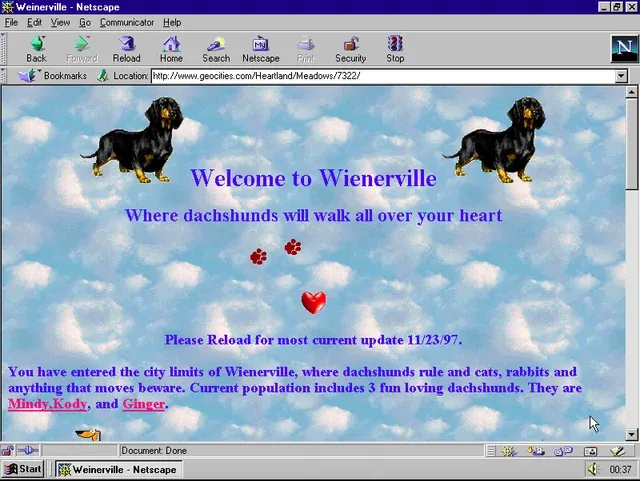
This was the era of GeoCities, the free hosting platform that by 1999 had become the third-most-visited website in the world. GeoCities gave millions of people their first taste of web publishing, and the results were gloriously chaotic: tiled backgrounds, animated "under construction" GIFs, auto-playing MIDI music, and visitor counters proudly displayed at the bottom of every page. JavaScript had only existed since 1995, and its primary use cases were scrolling marquee text and annoying pop-up windows.
HTML 4.0 had just been published, Flash was beginning to emerge as a creative tool (though still under the name Macromedia Flash), and the concept of "responsive design" wouldn't exist for another decade. Websites were static documents, not applications. The idea that a browser could render 3D graphics, run complex animations, or deliver the kind of immersive experience we take for granted today? Pure science fiction.
And then The Matrix arrived and showed audiences what a digital world could look like.
The Digital Rain Effect: How Green-on-Black Became a Design Language
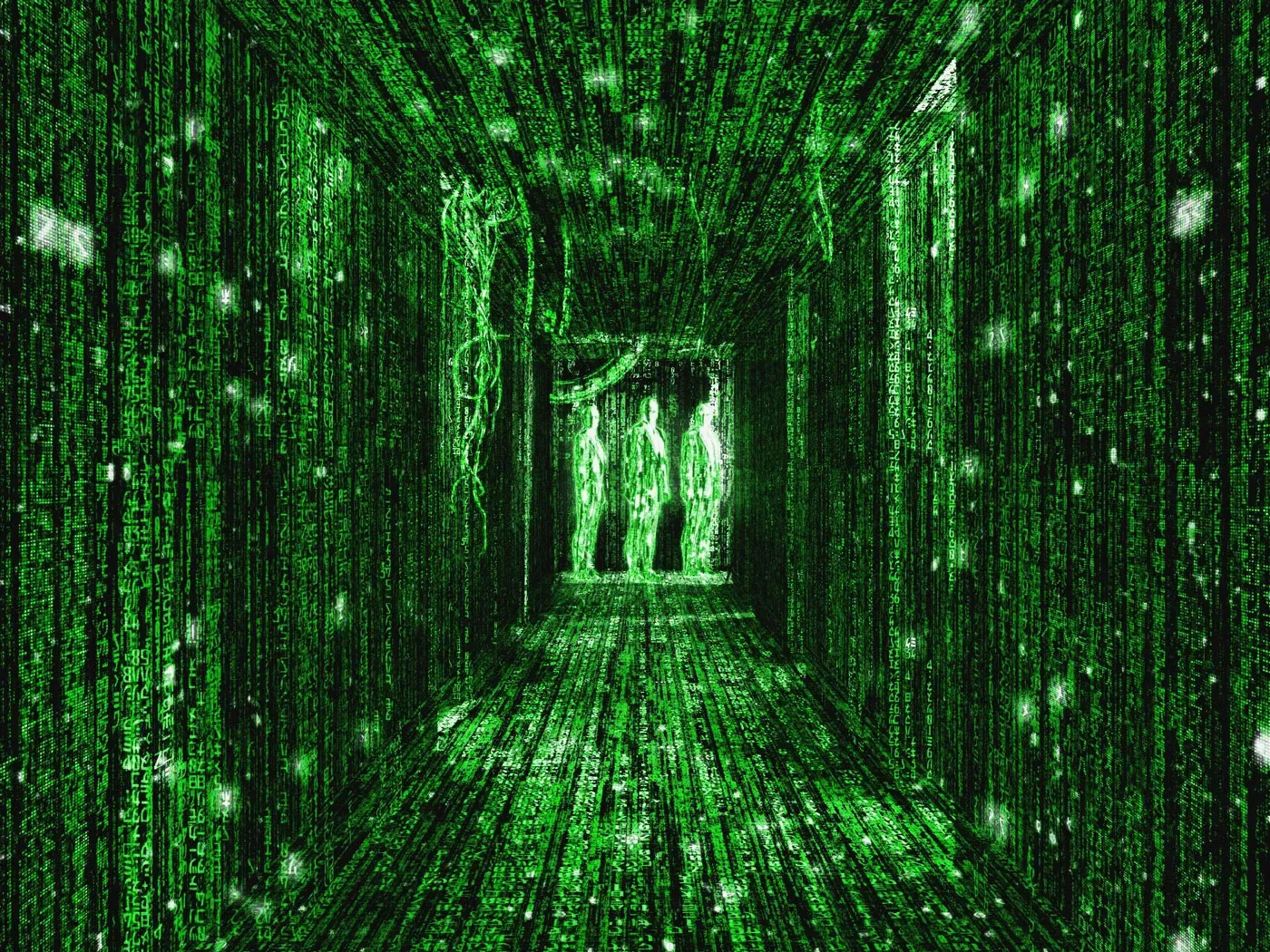
No visual element from The Matrix has proven more enduring than the cascading green code (officially known as "digital rain" or "Matrix code.") Those vertically falling characters became the single most recognizable representation of code and hacking in popular culture, and their influence on web design has been enormous.
The effect was designed by Simon Whiteley, who created a custom typeface featuring mirrored half-width Japanese katakana characters mixed with Latin letters and numerals. In a 2017 interview, Whiteley attributed the design partly to his Japanese wife, joking that the Matrix's code was essentially made out of Japanese sushi recipes. The green-on-black color scheme itself was a deliberate callback to early monochrome CRT monitors from the 1970s and 1980s, where phosphorescent green text on black backgrounds was a technical necessity, not an aesthetic choice.
What The Matrix did was transform that utilitarian look into something aspirational. Before the film, green-on-black terminals were associated with dated technology: the domain of old mainframes gathering dust in university basements. After the film, that same aesthetic suddenly signified mastery, power, and hidden knowledge. It looked cool.
From Screensavers to Dark Mode
The impact was immediate and measurable. The official Matrix website (whatisthematrix.com, launched in 1998) became one of the most visited movie promotional sites of its era, featuring Flash-based interfaces with the iconic green rain aesthetic. The site even offered an official screensaver that simulated the falling code effect and millions of people downloaded it. Unofficial Matrix screensavers proliferated across the early web, including the "GL Matrix" mode in XScreenSaver and the popular cmatrix program for Unix-like systems that remains available today.
But the deeper influence played out over decades. The Matrix didn't invent dark interfaces, but it gave them a cultural narrative and a reason to exist beyond mere function. That narrative created a throughline from the hacker aesthetic of the late 1990s to the dark mode revolution that swept through mainstream technology two decades later. When Apple introduced system-wide dark mode in macOS Mojave in 2018, and iOS 13 and Android 10 followed in 2019, they were building on decades of cultural groundwork that The Matrix had laid. By 2025, approximately 82% of smartphone users have dark mode enabled. The film didn't cause that shift on its own, but it made dark interfaces feel sophisticated rather than antiquated.
Bullet Time for the Browser: Interactivity and the Push for 3D
The Matrix's other signature innovation was "bullet time": the visual effect where time appears to freeze while the camera sweeps fluidly around the scene. It was the first mainstream use of what the industry calls virtual cinematography, and its impact on web development was less about direct imitation and more about raising the bar for what audiences expected from digital experiences.
After The Matrix, static web pages felt flat in a way they hadn't before. Users who had watched Neo bend the rules of a simulated reality increasingly expected websites to feel dynamic, responsive, and immersive. This cultural pressure didn't create the technologies that followed, but it accelerated demand for them.
The Flash Era (2000–2010)
The most immediate beneficiary was Macromedia Flash. The late 1990s and early 2000s saw Flash transform from a simple animation tool into the backbone of creative web design. Flash websites burst with the kind of interactivity and cinematic flair that The Matrix had made audiences crave: animated intros, smooth transitions, interactive navigation, and multimedia-rich experiences that standard HTML couldn't deliver.
The period from roughly 2000 to 2007 is considered the golden age of Flash web design. Creative agencies, bands, and entertainment companies built elaborate interactive experiences that pushed the boundaries of what a browser could do. Movie studios in particular embraced Flash to create immersive promotional websites and the influence of The Matrix's dark, cinematic aesthetic was unmistakable in many of these designs. The whatisthematrix.com official site itself was a Flash-based experience featuring interactive code-entry screens and hidden content unlocked through binary codes found across the franchise's products.
Flash ultimately died (Adobe ended support in 2020), but its legacy lives on. The desire for rich, interactive, cinematic web experiences that Flash pioneered (and that The Matrix helped audiences demand) didn't disappear. It simply migrated to new technologies.
WebGL, Three.js, and the 3D Web (2011–Present)
The torch passed to WebGL, a JavaScript API that brought hardware-accelerated 3D graphics to the browser without plugins. WebGL emerged in 2011 through a collaborative effort between Mozilla, Google, Apple, and Opera, and it finally delivered on a promise that Flash had only approximated: true 3D rendering directly in the browser, leveraging the GPU for performance that would have been unthinkable in 1999.
The real democratization came with Three.js, a JavaScript library created by Ricardo Cabello (known online as Mr.doob) in April 2010. Three.js abstracted away the complexity of raw WebGL programming, making it possible for web developers without graphics programming backgrounds to create sophisticated 3D scenes, animations, and interactive experiences. The library now has over 2,000 contributors on GitHub and powers everything from product configurators to virtual showrooms to digital art installations. In fact the globe on our home page is modeled using Three.js.
"I Know Kung Fu": View Source Culture and the Mystique of Code
Perhaps The Matrix's most profound impact on web development wasn't aesthetic at all. It was philosophical. The film made code itself look compelling in a way no piece of media had managed before.
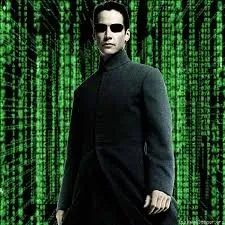
Before 1999, the popular image of a programmer was deeply unflattering. Hackers were stereotyped as spectacle-wearing teenagers hunched over bulky computers in their parents' bedrooms. While I'm not exactly fighting that stereotype (particularly the bispectacled, shrimp-posture allegations), Neo changed that archetype completely. Here was a programmer who was cool, capable, and whose technical knowledge gave him literal superpowers. The idea that understanding code meant understanding the fundamental structure of reality was awesome, and it arrived at precisely the moment when the web was making code accessible to ordinary people for the first time.
The View Source Generation
In the late 1990s and early 2000s, every web browser shipped with a feature that seems almost quaint now: "View Source." Right-click any web page, select the option, and you could see the raw HTML behind what you were looking at. For a generation of aspiring developers, this was their red pill moment. Just as Neo learned to see the Matrix's code flowing beneath the surface of simulated reality, young web enthusiasts discovered they could peek behind the curtain of any website and see how it was built.
The Matrix made code feel like hidden knowledge worth pursuing. View Source provided the mechanism for pursuing it. GeoCities and similar platforms provided the canvas for experimenting with what you learned. And the emerging open-source movement (Netscape had released its browser source code in 1998, and Linux was gaining serious momentum) provided the philosophical framework: code should be visible, shareable, and collaborative.
The result was an entire generation of self-taught web developers who learned by reading, copying, and modifying other people's HTML. They didn't attend bootcamps (those didn't exist yet) or watch YouTube tutorials (YouTube wouldn't launch until 2005). They right-clicked, viewed source, and taught themselves.
Timeline: The Matrix's Ripple Effect on Web Design (1999–2025)
The Matrix didn't influence web development in a single moment. Its effects rippled outward across more than two decades, intersecting with technological shifts at every stage.
1999: The Matrix Premieres
The web runs on HTML tables, GeoCities pages, and dial-up connections. Internet Explorer dominates. CSS exists but is poorly supported. The film introduces audiences to the concept of a coded reality and immediately becomes the aesthetic reference point for anything related to hacking, code, or digital culture. The official whatisthematrix.com becomes a landmark Flash website.
2000–2003: The Flash Golden Age
Macromedia Flash enables the first wave of cinematic web experiences. Dark interfaces, animated intros, and interactive navigation proliferate — heavily influenced by The Matrix aesthetic. The sequels (The Matrix Reloaded and The Matrix Revolutions, both 2003) extend the franchise's visual language and introduce even more sophisticated UI concepts through in-film screen graphics.
2003–2007: CSS Zen Garden and Web Standards
CSS Zen Garden launches in 2003, demonstrating that HTML and CSS alone can create beautiful, varied designs. The web standards movement gains momentum. Developers begin separating content from presentation, echoing The Matrix's theme of seeing beneath surface appearances to the underlying structure.
2007–2010: The iPhone and the Death of Flash
Steve Jobs' refusal to support Flash on the iPhone (2007) begins Flash's slow decline. The demand for rich, interactive web experiences doesn't disappear though, it just shifts toward HTML5, CSS3, and JavaScript. Dark, cinematic UI design persists in native apps and gaming interfaces.
2011: WebGL Arrives
WebGL launches across major browsers, bringing hardware-accelerated 3D graphics to the web without plugins. Three.js follows, democratizing 3D web development. The dream of truly immersive browser-based experiences finally becomes technically feasible.
2016–2019: Dark Mode Goes Mainstream
Microsoft introduces a dark theme in Windows 10 (2016). Apple follows with macOS Mojave (2018) and iOS 13 (2019). Android 10 adds system-wide dark mode (2019). The CSS prefers-color-scheme media query is introduced, allowing websites to automatically serve dark interfaces. The aesthetic that The Matrix popularized becomes a standard UX feature.
2021: The Matrix Resurrections
The fourth film arrives, and Warner Bros. relaunches whatisthematrix.com with a modern interactive experience featuring the red pill/blue pill choice. The site generates over 180,000 unique teaser video variations based on user choice and time of day.
2025: The Legacy Continues
Cyberpunk and dark UI aesthetics are experiencing a major revival across web design. WebGL and Three.js power increasingly sophisticated 3D experiences. Dark mode is enabled by over 82% of smartphone users. The Matrix's visual language has become so thoroughly absorbed into web design that many developers use it without even realizing where it came from.
Actionable Design Lessons from The Matrix
The Matrix wasn't just a cool movie. Buried within its aesthetic and narrative are genuine design principles that hold up remarkably well for modern web development.
1. Dark Themes Work: When They Serve a Purpose
The Matrix's green-on-black palette wasn't arbitrary. It communicated something specific: you're looking at code, at the hidden layer beneath the surface. The lesson for web designers is that dark themes are most effective when they serve a functional or emotional purpose (highlighting visual content, reducing eye strain for extended use, or conveying sophistication and technical depth).
Don't slap a dark background on your site because it looks trendy. Use it because it enhances your content. Media-heavy portfolios, developer tools, entertainment platforms, and evening-use applications all benefit from dark themes. Text-heavy documentation or e-commerce product pages often don't. And always implement dark mode as an option with a light alternative and respect your users' preferences by supporting the CSS prefers-color-scheme media query.
2. Animation Should Reveal, Not Decorate
The Matrix's most memorable visual effects (the digital rain, bullet time, the training program simulations) all served narrative purposes. They revealed something about how the world worked. The best web animations follow the same principle: they should communicate information, guide attention, or provide feedback. Loading indicators that show progress, hover states that reveal interactive elements, transitions that maintain spatial context during navigation - these are animations that mean something.
If your animation doesn't help the user understand your interface better, it's decoration. And decoration gets old fast.
3. Progressive Disclosure Is "Going Deeper"
The Matrix's narrative structure is essentially progressive disclosure. Neo starts with surface reality, then discovers there's a layer beneath it, then learns to manipulate that layer, then transcends it entirely. Great web interfaces work the same way: they present essential information first and reveal complexity as users go deeper.
Don't front-load every feature on your homepage. Design journeys that reward exploration, where each interaction reveals new capabilities or content. Dashboard designs, documentation sites, and SaaS onboarding flows all benefit from this layered approach.
4. Every Great Interface Tells a Story
The Matrix succeeded because it wasn't just a collection of cool visual effects. It was a coherent story about the relationship between humans and technology. Similarly, the best websites aren't just collections of well-designed pages: they tell a cohesive story about who you are, what you offer, and why it matters.
Your typography, color palette, interaction patterns, and content should all serve a unified narrative. When they do, your site doesn't just look good, it feels right. And that feeling is what keeps users engaged.
Conclusion: See the Code
It's been over twenty-six years since The Matrix premiered, and its fingerprints are everywhere on the modern web. Every time you toggle dark mode on your phone, every time a website loads a 3D product viewer in your browser, every time a junior developer right-clicks "Inspect Element" to understand how a page works, echoes of that 1999 film are present.
The Matrix worked as both entertainment and cultural catalyst because it took something invisible and technical and made it visible, dramatic, and meaningful. It told audiences that the people who understand code understand reality at a deeper level than everyone else. That narrative attracted talent to web/software development, shaped aesthetic preferences that persist to this day, and raised the bar for what users expected from digital experiences.
The web of 1999 was built from HTML tables, spacer GIFs, and good intentions. The web of 2025 renders real-time 3D graphics, adapts to user preferences automatically, and delivers experiences that would have been indistinguishable from magic to a developer working in the GeoCities era. The Matrix didn't build that future single-handedly, but it showed us what to aim for.
As Neo himself might put it: the code was always there. The Matrix just taught us to see it.
Interested in building a web presence that's as thoughtfully designed as a Wachowski film? Launch Turtle helps businesses craft digital experiences that balance cutting-edge technology with purposeful design. Get in touch to start the conversation.
Works Cited
- Wikipedia. "The Matrix." Accessed February 2026.
- Wikipedia. "Digital Rain." Accessed February 2026.
- Wikipedia. "Three.js." Accessed February 2026.
- Wikipedia. "Light-on-dark Color Scheme (Dark Mode)." Accessed February 2026.
- Wikipedia. "History of the World Wide Web." Accessed February 2026.
- Wikipedia. "GeoCities." Accessed February 2026.
- AIGA Eye on Design. "A Brief History of 'Dark Mode' — From the Matrix-like Displays of the Early '80s to Today." September 2020.
- Web Design Museum. "Web Design History." Accessed February 2026.
- Web Design Museum. "The Matrix in 1999." Accessed February 2026.
- LottieFiles. "A History of Web Design: From GeoCities to Neubrutalism." February 2024.
- Highsnobiety. "'The Matrix' Will Always Be Remembered as a Major Turning Point in Hollywood." April 2019.
- NME. "The Matrix at 20: The Enduring Impact of the Sci-Fi Sensation." March 2019.
- Bold Entrance. "Source Code: The Visual Influences Behind 'The Matrix'." March 2023.
- Computer Graphics World. "De-Coding the Matrix." 2022.
- Matrix Wiki. "WhatIsTheMatrix.com." Accessed February 2026.
- GeekTyrant. "Warner Bros. Relaunches 'What Is the Matrix' Website for The Matrix: Resurrections." September 2021.
- Rocking Tech Blog. "The Rise and Fall of Flash Websites: When the 2000s Web Came Alive." June 2025.
- Spider Digital Group. "The Rise of WebGL." Accessed February 2026.
- Thrive Agency. "Why Users Love Dark Mode in Web Design and How to Implement It." December 2025.
- Aalto University. "Early Web (1990s)." Accessed February 2026.
Weekly Insights
Get actionable web development tips that actually work. No fluff, just proven strategies.
Join 5,000+ developers and business owners worldwide
Weekly insights • No spam • Unsubscribe anytime

Jackson White
Content Creator
Jackson is the founder and lead developer at Launch Turtle, bringing over 4 years of technical expertise to help small and mid-sized businesses establish powerful online presences. Let's Launch!